|
Are Flaps
Necessary?
It' s always amazing that with the wealth of information constantly flowing
from model aviation magazines and how-to books apparently so little is known
about model aerodynamics. Take aircraft flaps, for example. Unlike cyber-space
and high speed modems, aircraft flaps have been with us for eons, yet a mystery
persistently lingers about their true purpose, aerodynamic function and the
pros and cons of their virtues regarding scale R/C models. The simple truth is
that flaps and what they do, is the easiest type of airfoil to comprehend.
(Click on
Pictures to Enlarge) Though
flaps were first experimented with in the 1920s it was not until the advent of
the monoplane and its higher wing loading that they came into widespread use in
the rnid-1930s. Since monoplanes characteristically had h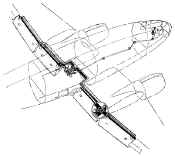 igher
stall speeds than most biplanes they subsequently landed at higher air speeds
and required more runway length to become airborne. To counter this increase in
landing and takeoff speeds the installation of flaps, or additional lift/drag
capability, was the logical answer. Aerodynamically, the flap is a barn door- a
lift/drag-creating device which permits slower landing speed and, therefore,
decreases the required landing distance. igher
stall speeds than most biplanes they subsequently landed at higher air speeds
and required more runway length to become airborne. To counter this increase in
landing and takeoff speeds the installation of flaps, or additional lift/drag
capability, was the logical answer. Aerodynamically, the flap is a barn door- a
lift/drag-creating device which permits slower landing speed and, therefore,
decreases the required landing distance.
Second, because they permit a
comparatively steep angle of descent without an increase in speed they offer
safe obstacle clearance on approaches to small airfields. An added benefit is
that they may be deployed to shorten takeoff distances and provide a steeper
climb path to altitude. An example of their effectiveness is seen in the
WWII-era 8-25 Mitchell, landing at a gross weight of 30,000 Ibs. With flaps up
the venerable Mitch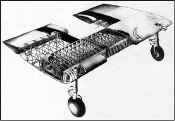 ell came "over the fence" at 120 MPH, whereas with
full 45-degree flap setting this speed was reduced to only 90 MPH with a
resulting decrease in rollout of only 2500 ft of runway, as opposed 4000-ft
with flaps up (and a lot less wear on brakes and tires). Since flaps allow
steeper angles of descent with the nose pitched lower, they also give pilots a
better view of the landing area. ell came "over the fence" at 120 MPH, whereas with
full 45-degree flap setting this speed was reduced to only 90 MPH with a
resulting decrease in rollout of only 2500 ft of runway, as opposed 4000-ft
with flaps up (and a lot less wear on brakes and tires). Since flaps allow
steeper angles of descent with the nose pitched lower, they also give pilots a
better view of the landing area.
Second style is the split flap which lowers from the bottom of the wing as
primarily a drag inducing surface. The split flap does not offer an appreciable
increase in lift and was successfully used on such aircraft as the Douglas DC-3,
British Spitfire, Curtis P-40, and North American T -6, among countless others.
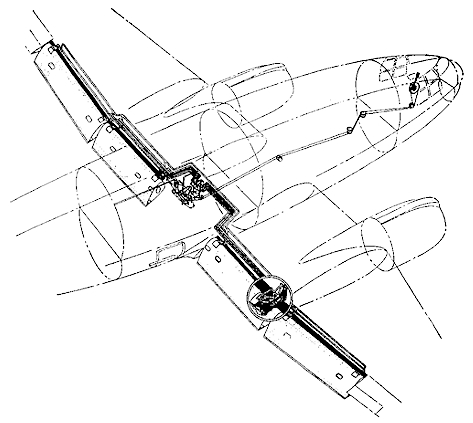
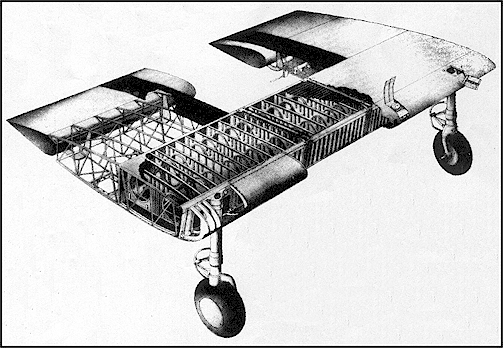
The third type was the patented Fowler Flap which deployed on tracks from
beneath the wing in an expanding manner that when fully deployed, also
increased the total wing area, thereby decreasing wing loading while still
providing additional lift and substantial drag.
Mechanically the most sophisticated flap device, the
patented Fowler-type was used on many of Lockheed's ea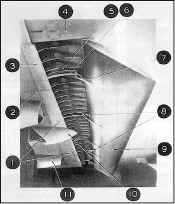 rly
twin-engine transports; the B-24 Liberator, and a number of
other wartime aircraft. In differing versions the
Fowler-type is still widely used on today's jet airliners.
As to the matter of flap use for takeoff this was determined
by each manufacturer since effectiveness varied with the
type of airfoil used, engine power ratios, load factors,
etc. Cessna' s long-lived classic 182 series at first needed
no additional boost to take-off from the average general
aviation airport of the 1950s. rly
twin-engine transports; the B-24 Liberator, and a number of
other wartime aircraft. In differing versions the
Fowler-type is still widely used on today's jet airliners.
As to the matter of flap use for takeoff this was determined
by each manufacturer since effectiveness varied with the
type of airfoil used, engine power ratios, load factors,
etc. Cessna' s long-lived classic 182 series at first needed
no additional boost to take-off from the average general
aviation airport of the 1950s.
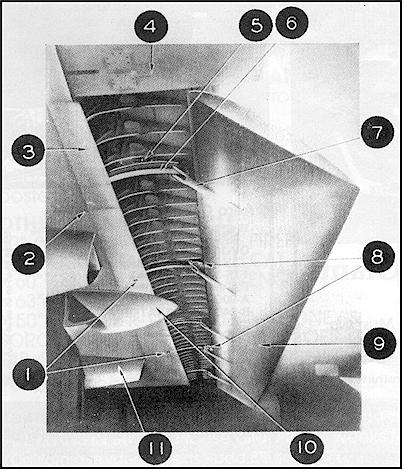
Fowler Flap
installation showing (1) up-stop inspection slots, (2) wing
Splice, (3) wing T.E., (4) aileron, (5) flap-track support,
(6) flap track, (7) flap carriage, (8) flap extending cable
attachments, (9) flap, (10) wheel well fairing, (11) engine
nacelle fairing. When Cessna revised the airfoil
in its 1977 models for better stall characteristics the pilot's handbook then
recommended the use of 20-degree flap settings for ALL takeoffs. Large high
performance aircraft like the B-25 Mitchell require 20-degree flap
settings for take-off, yet oddly enough one of Jimmy Doolittle's B-25 TOKYO
RAIDERS mistakenly took off from the deck of the USS Hornet without lowering any
flap on the launch of their historic 1942 bombing mission. Named the
"Ruptured Duck," and piloted by the late Lt. Ted Lawson, the
heavily-loaded bomber dipped precariously close to the sea but did manage to fly
after a deck run of 700 feet with maximum fuel and bomb load.
That's how flaps perform on big birds but are they truly necessary on scale
RC models? The answer boils down to a matter of scale size. The larger the scale
the more the model emulates the flying characteristics of its full size counter
part. This is because air density does not vary while airfoil lift factors do.
Mathematically, Reynolds numbers which deal with theoretical chordwise airfoil
lift factors com into play. Without getting to far into the math books, lets
just say that large scale models of high performance aircraft, like most
WWII-era fighters and bombers, greatly benefit from operating flaps. Contrarily, they are of
dubious value on large scale (over 5-foot wingspan) light planes such as the
Piper Cub, Taylorcraft BC-12D and Aeronca 7 AC Champ varieties which inherently
boast light wing loadings and have slow landing speeds.
 Remember
too, that
improperly used or deployed too prematurely flaps can be hazardous to flight
performance since they drastically alter approach speeds to landing. The matter
of model size is critical in regard to approach airspeeds since flaps on a small
36-inch Piper Tri-Pacer will also serve to lower its landing speed, just as they would on a small
scale Spitfire, or P-5l Mustang. The difference here is the problem of
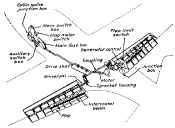
additional mechanism weight; the complications of additional servos, push rods,
bell-cranks Remember
too, that
improperly used or deployed too prematurely flaps can be hazardous to flight
performance since they drastically alter approach speeds to landing. The matter
of model size is critical in regard to approach airspeeds since flaps on a small
36-inch Piper Tri-Pacer will also serve to lower its landing speed, just as they would on a small
scale Spitfire, or P-5l Mustang. The difference here is the problem of
additional mechanism weight; the complications of additional servos, push rods,
bell-cranks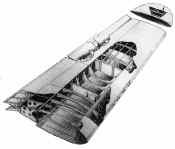 , etc. In other words, the question becomes a trade-off in handling
effectiveness versus model flying efficiency; which is more valuable? The
smaller the model the more critical weight becomes. Is this then a viable
trade-off in a light model that has reasonably slow approach speeds? Personally,
I doubt it is. , etc. In other words, the question becomes a trade-off in handling
effectiveness versus model flying efficiency; which is more valuable? The
smaller the model the more critical weight becomes. Is this then a viable
trade-off in a light model that has reasonably slow approach speeds? Personally,
I doubt it is.
To summarize the question of flaps we have only to look at the
great air racers of the 1930s -the speedy Gee Bees, Laird Solution, Mr. Mulligan and the others of their
era that broke world records at the Thompson
and Cleveland Air Races. Few of these speedsters were equipped with flaps
because the weight of this additional mechanism would denigrate their quest for
pace-setting speed. For the most part these were finely-tuned machines primarily
built for a single purpose, to win trophies and break records. They were flown
by the hottest pilots in the world from large airfields that could handily
accommodate today's Boeing 747. The answer then "to flap or not to flap"
lies
strictly in the type and size of scale model a R/C pilot is skilled enough to
handle. The choice is yours alone...
Scale & Giant Scale R/C is Sponsored by:
Scale Flyers of Minnesota -
Terms of Use /
Privacy Policy |